Study Guide: Quiz 4
Mesopotamian Mathematics
Note: This is a study guide. The quiz will consist of three or four questions covering the material below. If you understand the ideas and facts in the non-computational questions and can work through the computational problems, you will be well prepared.
Part 1: Quiz-Style Questions
- Convert 7/5 and 33/50 to sexagesimal (base-60) notation.
- Find the reciprocals in base 60 of 18 and 32. (Recall: in this context, the product of a number with its reciprocal can be any power of 60.) Remark: Tables of reciprocals important in Mesopotamian mathematics because allowed the to perform division by using the relation A ÷ B = A × (1/B).
- Square-root algorithm (Babylonian method): Starting from guess a = 3/2, compute one iteration to approximate √2. Explain the update step in words. Sketch the corresponding figure(s).
- In Old Babylonian geometry, each geometrical figure has a defining component (typically a particular length of a curve or segment), from which its other parameters are computed. A coefficient is a fixed numerical constant that relates one of these parameters (for example, a length or an area) to the defining component: multiplying the defining component (or its square) by the coefficient yields that parameter.
The defining component of a circle was the circumference, and the coefficient for the diameter was 1/3.
- (a) Write a formula expressing the diameter d in terms of the circumference c using this coefficient. Provide a numerical example.
- (b) Give a modern interpretation of this coefficient. What does it tell us about Babylonian knowledge of the relationship between circumference and diameter?
- The following is a problem from a Babylonian tablet, 1900–1600 BCE. "I found a stone but did not weigh it. After I subtracted 1/7, added 1/11 [of the difference], and then subtracted 1/13 [of the previous total], it weighed 1 mina. What was the stone's weight?"
- (a) Set up an equation with unknown x whose solution answers the problem.
- (b) Do you think this problem had a practical application or was mathematics for its own sake?
- Two squares problem (Babylonia, c. 1800–1600 BCE): "I have added the areas of my two squares; [result] (25,25)60. [The side of] the second square is 2/3 the side of the first plus 5." Set up the equation(s) needed to solve this problem in the Hindu-Arabic number system.
- Express the numbers A. B. and C. first in base 60 and then in Hindu-Arabic numerals:
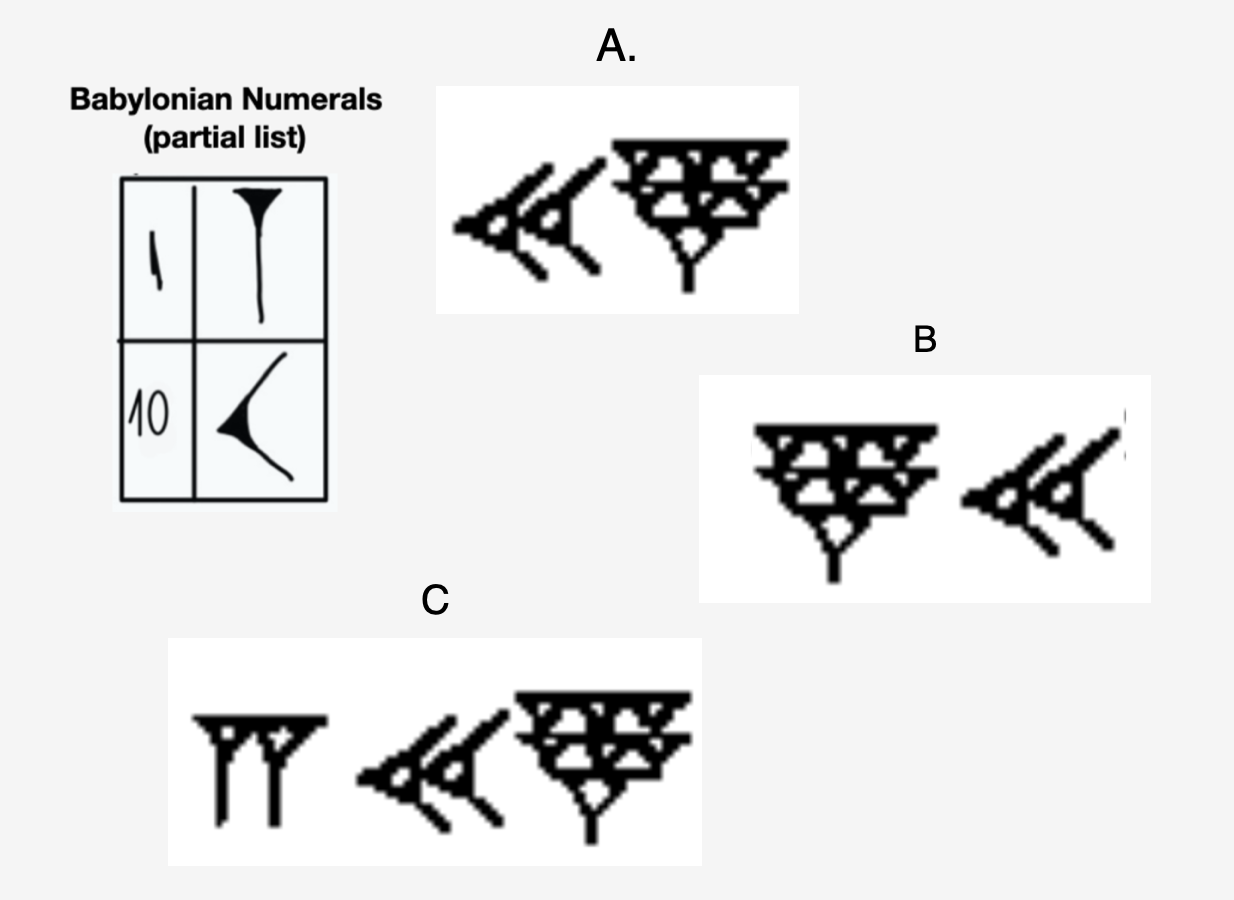
Babylonian numerals and three numbers
- Explain one concrete way in which the environment could have pushed societies toward abstraction (numbers, calendars, or writing).
- We inherited 360° circles and 60-minute hours from Mesopotamia. Does this continued use prove that these were the best choices? Or was it a mix of tradition and efficiency, with the balance hard to determine?
- King Šulgi's praise poem presents mathematical skills as royal achievements linked to "knowledge and comprehension." What does this reveal about how Mesopotamian culture valued mathematics?
Part 2: Reflection Questions
- How does a written law code (like Hammurabi's) change the nature of justice compared to an oral tradition?
- Compare Egyptian and Mesopotamian approaches to fractions. How did their different number systems lead to different computational strategies?
- A Mesopotamian scribe needs to divide 47 by 7 using only multiplication and reciprocal tables. Explain the problem the scribe faces and what strategies might work.
- Mesopotamian mathematics that we know from clay tablets appears primarily in administrative and practical contexts (canal digging, field measurement, wages). What does this tell you about who was doing mathematics and why?
- How did the clay tablet medium shape what kind of mathematics Mesopotamians could do? Would their methods have been different on papyrus or parchment?
Quiz Problem Rubric
| Points | Criteria |
|---|---|
| 3 | Correct answer with reasoning/work shown |
| 2 | Partially correct with some reasoning shown |
| 1 | Correct answer without reasoning/work OR significant attempt with some understanding |
| 0 | Incorrect or blank |
Notes
- For computational problems: "reasoning/work" = steps shown
- For conceptual problems: "reasoning" = explanation given
- Round partial credit up when in doubt