Study Guide: Quiz 10
Islamic Mathematics — Review of Earlier Material
Note: This is a study guide. The quiz will consist of three or four questions covering the material below. If you understand the ideas in the conceptual questions and can work through the reasoning in the others, you will be well prepared.
Part 1: Al-Khwārizmī — Completing the Square
Read the following demonstration and work through the exercises.
Demonstration: “A Square and Ten Roots are Equal to Thirty-Nine Dirhams”
The figure that explains this problem is a square with unknown side length, representing the square whose root we wish to find. Call this square AB, where each side represents a root. Multiplying a side by a number gives a rectangle whose area represents that many roots. Since the roots are combined with the square in this problem, we take one-fourth of ten — that is, two and a half — and add it to each of the four sides.
We attach four rectangles to square AB, each having a side of AB as its length and two and a half as its width. These are rectangles C, G, T, and K. We now have a figure with equal (but unknown) sides, except that at each corner a small square of side two and a half is missing. To fill these gaps and complete the large square, we add four times the square of two and a half — that is, twenty-five.
We know from the problem that square AB together with the four rectangles (representing the ten roots) equals thirty-nine. Adding twenty-five (the four corner squares that complete the large figure DH) gives sixty-four. The side of this large square is its root: eight.
Subtracting twice two and a half — that is, five — from eight removes the added lengths from both ends of the side of DH. The remainder, three, is the root of the original square: the side of AB.
Note: We halved the number of roots and added the square of that half to thirty-nine in order to complete the four corners. This works because one-fourth of any number, squared and multiplied by four, equals the square of half that number. So we square half the roots directly, rather than squaring one-fourth and multiplying by four.
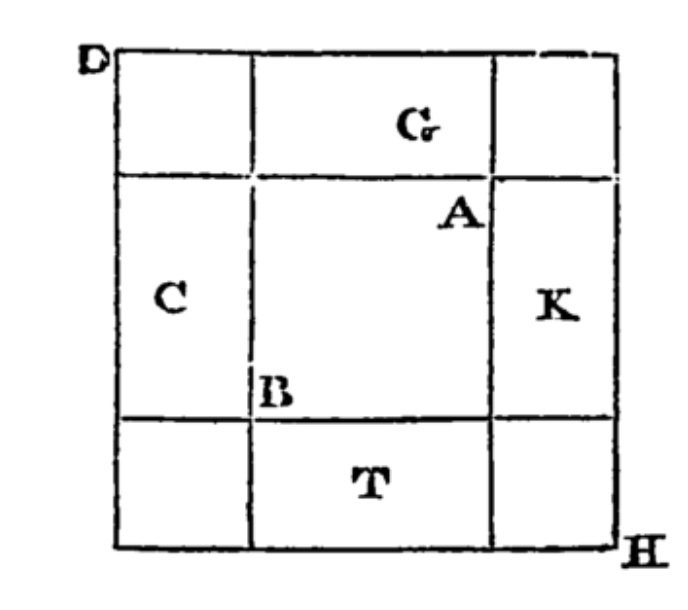
Square AB with rectangles C, G, T, K and completed large square DH
Exercises (First Method — Four Rectangles)
- Denote the side of AB by x, and find the area of one of the four attached rectangles (C, G, T, or K) in terms of x.
- Find the area of one corner square.
- Add the areas of the four corner squares to the areas of AB, C, G, T, and K to get the area of the large square DH.
- The original square AB plus the four rectangles equals 39. What is the total area of the completed large square DH?
- What is the side length of DH?
- What is x, the side length of the original square AB?
Second Method (Two Rectangles)
We again start with square AB. We halve the ten roots to get five, and attach two rectangles — G and D — to two sides of AB. Each rectangle has length five and width equal to a side of AB.
A small square remains at the corner opposite AB, with side five (half the number of roots). The original square plus the two rectangles equals thirty-nine. To complete the large square SH, we add this corner square: five times five equals twenty-five. So the large square has area sixty-four, and side eight.
Subtracting five — the quantity we added — from eight gives three: the side of AB, the root we were seeking. The square itself is nine.
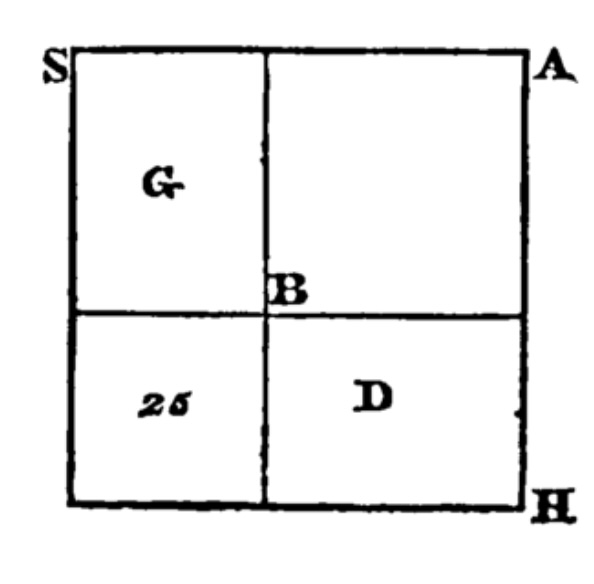
Square AB with rectangles G and D and completed large square SH
Exercises (Second Method — Two Rectangles)
- Denote the side of AB by x, and find the area of one of the two rectangles (G or D) in terms of x.
- Find the area of the corner square.
- Add the areas of AB, G, D, and the corner square to get the area of SH.
- The original square plus the two rectangles equals 39. Find the total area of SH in actual numbers.
- What is the side length of SH?
- What is x?
Part 2: Quiz-Style Questions
Islamic Mathematics
- In what century did the Islamic Golden Age begin, and what political change marks its start?
- What was the House of Wisdom, and what role did it play in the development of Islamic mathematics?
- Name three mathematical works translated into Arabic during the Islamic Golden Age. Why were these translations important?
- Give two reasons why scholarship flourished in the Islamic world during this period.
- What does the phrase “seek knowledge from the cradle to the grave” suggest about attitudes toward learning in the Islamic Golden Age?
- What happened to Greek mathematical knowledge when it entered the Islamic world — was it simply preserved, or something more?
- Give one concrete mathematical development of the Islamic Golden Age.
- What is meant by the phrase “Arabic became the language of science”? What were the practical consequences of this for scholarship?
- Who was al-Khwārizmī? Name his approximate century and the main ideas in his work.
- Al-Khwārizmī classified six types of equations. List all six using his terminology, and write one example of each type in modern notation.
- In al-Khwārizmī’s algebra, why are only positive solutions accepted?
- What is an astrolabe? The astrolabe works because stereographic projection has two key properties — name them.
- Name two practical uses of the astrolabe.
Review: Mesopotamia
- Explain one concrete way in which the environment could have pushed a society toward abstraction — in numbers, calendars, or writing.
- Find the reciprocals in base 60 of 18 and 32. Recall: in this context, the product of a number with its reciprocal can be any power of 60. Note: tables of reciprocals were important in Mesopotamian mathematics because they allowed scribes to perform division using the relation A ÷ B = A × (1/B).
- The defining component of a circle in Old Babylonian mathematics was its circumference, and the coefficient for the diameter was 1/3. What does this tell us about Babylonian knowledge of the relationship between circumference and diameter?
Review: Plimpton 322
- What is Plimpton 322? Where was it found, and when is it dated?
- Name the three interpretations of Plimpton 322 discussed in class and briefly describe each.
- Give at least one reason scholars argue Plimpton 322 cannot be a table of Pythagorean triples.
Review: Hellenic Mathematics before Euclid
- According to Aristotle, what is an axiom, and how is it used in mathematical reasoning?
- Why can’t the Pythagorean theorem be reliably attributed to Pythagoras? Where is the first extant axiomatic proof?
- State the three classical problems of Greek geometry and explain what they have in common.
Part 3: Reflection Questions
- Greek knowledge did not simply pass into the Islamic world unchanged — it was translated, debated, extended, and criticized. What does this suggest about how mathematical knowledge actually travels between cultures?
- Al-Khwārizmī solved quadratic equations geometrically rather than symbolically. What does this tell us about the relationship between algebra and geometry at the time?
- Al-Khwārizmī excluded negative solutions on the grounds that a root must correspond to a physical length. How does this compare to how mathematicians treat negative numbers today? What does it reveal about how meaning shapes mathematics?
- The astrolabe encoded centuries of astronomical knowledge into a handheld instrument. What does it mean to compress knowledge into a tool? What might be gained, and what lost?
- Looking across Mesopotamia, Greece, and the Islamic world: what patterns do you notice in how mathematical knowledge is transmitted, transformed, and extended across cultures?
Quiz Problem Rubric
| Points | Criteria |
|---|---|
| 3 | Correct answer with reasoning or work shown |
| 2 | Partially correct with some reasoning shown |
| 1 | Correct answer without reasoning, or a significant attempt showing some understanding |
| 0 | Incorrect or blank |
Notes
- For computational problems: “reasoning/work” means steps shown.
- For conceptual problems: “reasoning” means explanation given.
- Round partial credit up when in doubt.